Beaches
Recent Articles
More Articles
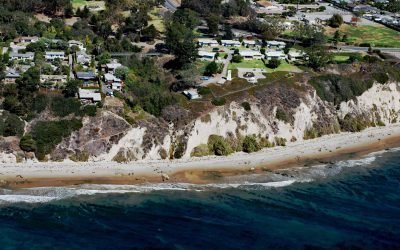
Santa Barbara Lighthouse, Santa Barbara
The Santa Barbara Lighthouse is located between the East Mesa and West Mesa neighborhoods, about 2 miles (3 km) west of Santa Barbara Harbor, in the City of Santa Barbara, California.
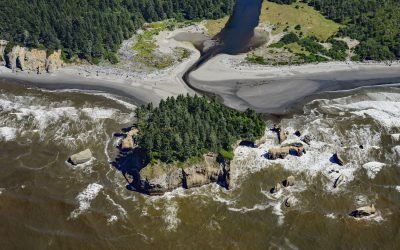
Tunnel Island, Raft River
The Raft River, a stream located entirely within the Quinault Indian Reservation on the Olympic Peninsula, flows into the Pacific Ocean at Tunnel Island, approximately 9 miles (14 km) north of Taholah, Washington.
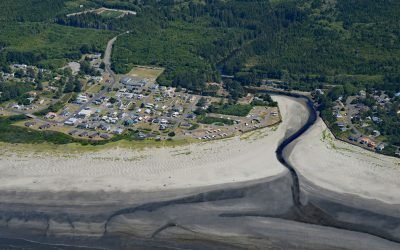
Joe Creek, Pacific Beach
Pacific Beach is a community situated at the mouth of Joe Creek, where the estuary is a strongly stratified lagoon with freshwater overlying saline water caused by a shallow sill that restricts circulation, about 25 miles (40 km) northwest of Hoquiam and 11 miles (18 km) south of Moclips, Washington.
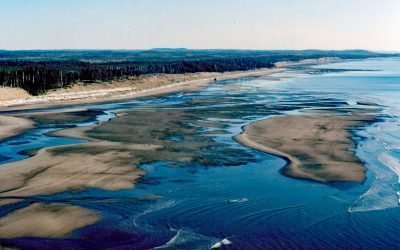
SS Pezuta, Tlell River
The Tlell River flows generally north-northeast for 28 miles (45 km) to Hecate Strait, near the wreck of the steamship SS Pezuta, about 29 miles (47 km) south-southeast of Masset and 4.5 miles (7 km) north of Tlell, British Columbia.
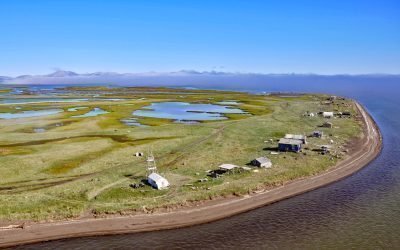
Sheshalik Spit, Kotzebue Sound
Sheshalik is a spit about 6 miles (10 km) long consisting of accretionary beach ridges with some lagoons situated in Cape Krusenstern National Monument on Kotzebue Sound, about 40 miles (64 km) south of Noatak and 10 miles (16 km) northwest of Kotzebue, Alaska.
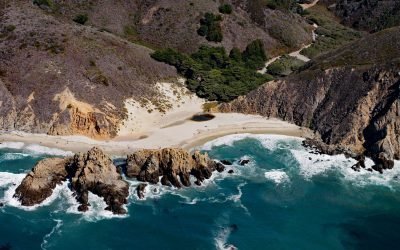
Sycamore Creek, Pfeiffer Beach
Sycamore Creek flows to Pfeiffer Beach on the Big Sur coast, about 26 miles (42 km) south of Monterey and 21 miles (34 km) northwest of Lucia, California.
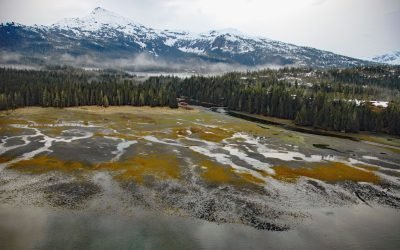
Cannery Creek, Unakwik Inlet
Cannery Creek is the site of a salmon hatchery on the eastern shore of Unakwik Inlet in Prince William Sound and the Chugach National Forest, about 42 miles (68 km) northeast of Whittier and 41 miles (66 km) west-southwest of Valdez, Alaska.
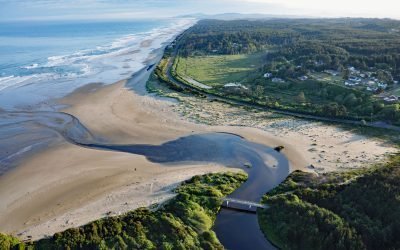
Beaver Creek, Ona Beach
Beaver Creek flows generally west for 16 miles (26 km) to the Pacific Ocean at Ona Beach, approximately 9 miles (14.5 km) south of Newport and 7 miles (11.3 km) north of Waldport, Oregon.
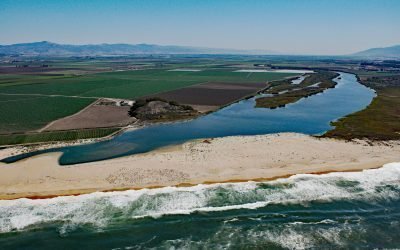
Salinas River, Castroville
The Salinas River begins in the central California Coast Ranges and flows 175 miles (282 km) generally northwest to Monterey Bay, approximately 12 miles (19 km) north-northeast of Monterey and 3 miles (5 km) west-southwest of Castroville, California.
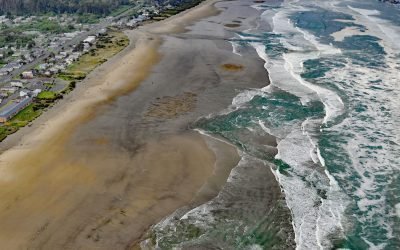
Twin Rocks, Rockaway Beach
Twin Rocks is a set of sea stacks situated about 0.5 miles (0.8 km) offshore and 1 mile (1.6 km) south-southwest of Rockaway Beach, a seaside community on a continuous strand that extends for 6 miles (10 km) from the mouth of the Nehalem River to the north and Tillamook Bay to the south, about 4 miles (6 km) south-southwest of Nedonna Beach and 2 miles (3.2 km) north-northwest of Barview, Oregon.
About the background graphic
This ‘warming stripe’ graphic is a visual representation of the change in global temperature from 1850 (top) to 2019 (bottom). Each stripe represents the average global temperature for one year. The average temperature from 1971-2000 is set as the boundary between blue and red. The colour scale goes from -0.7°C to +0.7°C. The data are from the UK Met Office HadCRUT4.6 dataset.
Click here for more information about the #warmingstripes.