
Glaciers
Recent Articles
More Articles
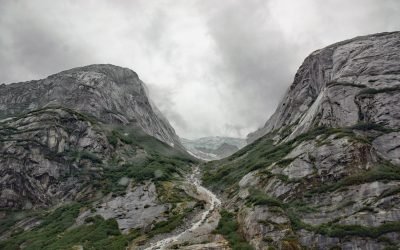
Cirque Glacier, Endicott Arm
An unnamed glacier hangs above a cirque on the southern shore of Endicott Arm, a fjord in the Coast Mountains of Southeast Alaska that extends northwest for 33 miles (53 km) from the terminus of the Dawes Glacier to Holkham Bay, 80 miles (129 km) southeast of Juneau and 47 miles (76 km) north of Petersburg, Alaska
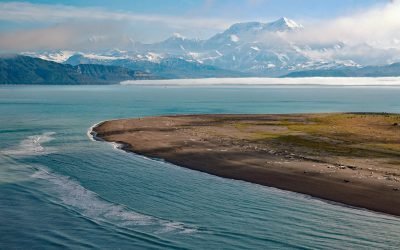
Mount Saint Elias, Icy Bay
Mount Saint Elias is situated at the head of Icy Bay on the Alaska-Canada boundary in the Saint Elias Range, about 165 miles (266 km) east-southeast of Cordova and 67 miles (108 km) northwest of Yakutat, Alaska.
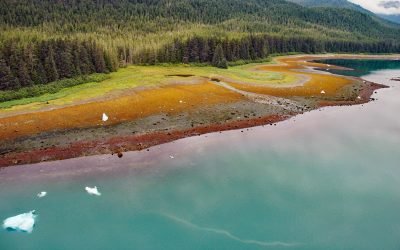
Tracy Arm, Tracy Arm-Fords Terror Wilderness
Tracy Arm is a fjord in the Coast Mountains of Southeast Alaska about 85 miles (137 km) northeast of Sitka and 42 miles (67.7 km) southeast of Juneau, Alaska.
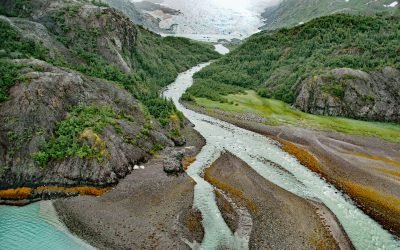
Falling Glacier, Kings Bay
Falling Glacier starts at the northwest end of the Sargent Icefield in the Chugach Mountains and flows northwest for 3 miles (4.8 km) to the eastern shore of Kings Bay, about 39 miles (63 km) northeast of Seward and 20 miles (32 km) south-southeast of Whittier, Alaska.

Princeton Glacier, Nassau Fjord
Princeton Glacier is on the east side of the Kenai Peninsula, about 37 miles (60 km) south-southeast of Whittier and 38 miles (61 km) east-northeast of Seward, Alaska.
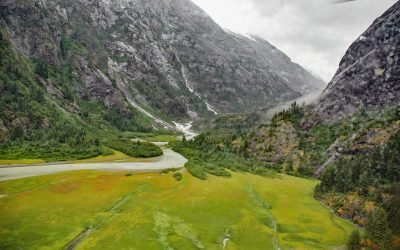
North Dawes Glacier, Endicott Arm
North Dawes Glacier starts from the Stikine Icefield at an elevation of about 5,200 feet (1,585 m) on the western flank of Sheppard Peak and flows generally southwest for 15 miles (24 km) to a proglacial lake at an elevation of 1000 feet (305 m) which is 2 miles (3.2 km) long and drained by a stream 1.3 miles (2.1 km) long at the head of an inlet extending north from Endicott Arm, about 74 miles (119 km) southeast of Juneau and 51 miles (82 km) north of Petersburg, Alaska.

Yahtse Glacier, Icy Bay
Yahtse Glacier starts from the south flank of Mount Miller in Barkley Ridge at an elevation of 8,200 feet (2,500 m) and flows generally southeast for 40 miles (65 km) through Wrangell-Saint Elias National Park and Preserve to a tidewater terminus between Guyot Hills to the west and Karr Hills to the east in Icy Bay, about 152 miles (245 km) east-southeast of Cordova and 71 miles (115 km) northwest of Yakutat, Alaska.

North Sawyer Glacier, Tracy Arm
Sawyer Glacier, also called North Sawyer Glacier, starts in the Coast Mountains of British Columbia at an elevation of about 6,600 feet (2,012 m) and flows generally west for 14 miles (23 km) to the Alaska border at an elevation of 3,600 feet (1,097 m) and then another 7 miles (11 km) to a terminus at sea level in Tracy Arm, about 78 miles (126 km) north of Petersburg and 53 miles (85 km) southeast of Juneau, Alaska.
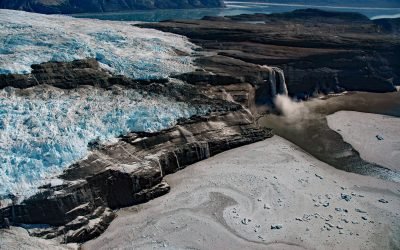
Kashteen Peninsula, Tsaa Fjord
Kashteen Peninsula is located in Wrangell-Saint Elias National Park and Preserve on the eastern shore of Icy Bay, between Tsaa Fjord to the south and Guyot Fjord to the north, and is emerging from under the retreating Guyot Glacier, about 149 miles (240 km) east-southeast of Cordova and 73 miles (118 km) northwest of Yakutat, Alaska.

Guyot Glacier, Icy Bay
Guyot Glacier starts from an elevation of about 6,700 feet (2,042 m) on the eastern flank of Yaga Peak in the Robinson Mountains and flows generally east-southeast for 34 miles (55 km) to its terminus just south of the Guyot Hills on the western shore of Icy Bay in Wrangell-Saint Elias National Park and Preserve, about 146 miles (235 km) east-southeast of Cordova and 76 miles (123 km) northwest of Yakutat, Alaska.
About the background graphic
This ‘warming stripe’ graphic is a visual representation of the change in global temperature from 1850 (top) to 2019 (bottom). Each stripe represents the average global temperature for one year. The average temperature from 1971-2000 is set as the boundary between blue and red. The colour scale goes from -0.7°C to +0.7°C. The data are from the UK Met Office HadCRUT4.6 dataset.
Click here for more information about the #warmingstripes.