
Waterfalls
Recent Articles
More Articles
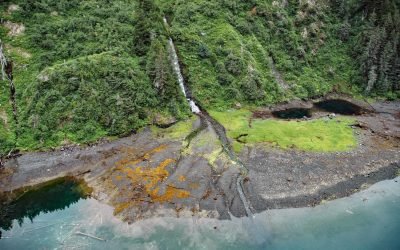
Jackpot Bay, Dangerous Passage
Jackpot Bay is a fjord on the Kenai Peninsula that extends west for 6.5 miles (10.5 km) from Dangerous Passage, about 43 miles (69 km) northeast of Seward and 34 miles (55 km) southeast of Whittier, Alaska.
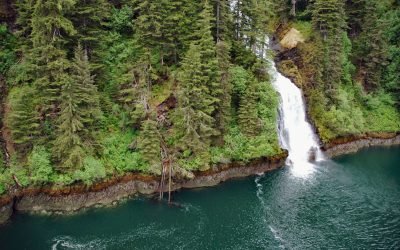
Red Bluff Bay, Baranof Island
Red Bluff Bay is a fjord about 4 miles (6.5 km) long and 0.3 miles (05. km) wide on the east coast of Baranof Island, opening into Chatham Strait, about 70 miles (113 km) west of Petersburg and 25 miles (40 km) southeast of Sitka, Alaska.
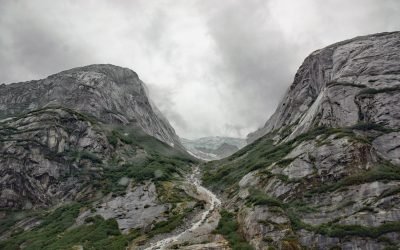
Cirque Glacier, Endicott Arm
An unnamed glacier hangs above a cirque on the southern shore of Endicott Arm, a fjord in the Coast Mountains of Southeast Alaska that extends northwest for 33 miles (53 km) from the terminus of the Dawes Glacier to Holkham Bay, 80 miles (129 km) southeast of Juneau and 47 miles (76 km) north of Petersburg, Alaska

Mount Douglas, Katmai National Park and Preserve
Mount Douglas is a stratovolcano with an elevation of 7,000 feet (2134 m) located on Kamishak Bay, near the northern part of the Alaska Peninsula and within Katmai National Park and Preserve, about 113 miles (182 km) east of King Salmon and 91 miles (147 km) southwest of Homer, Alaska.
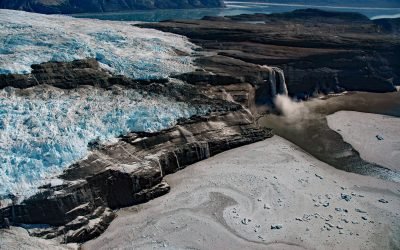
Kashteen Peninsula, Tsaa Fjord
Kashteen Peninsula is located in Wrangell-Saint Elias National Park and Preserve on the eastern shore of Icy Bay, between Tsaa Fjord to the south and Guyot Fjord to the north, and is emerging from under the retreating Guyot Glacier, about 149 miles (240 km) east-southeast of Cordova and 73 miles (118 km) northwest of Yakutat, Alaska.
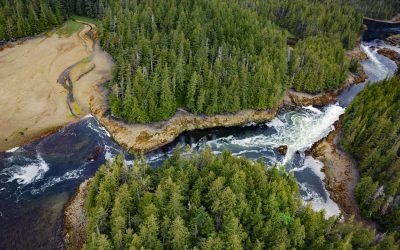
Salt Lagoon, Porcher Inlet
Salt Lagoon is situated at the southwestern base of the Spiller Range on Porcher Island and is connected by a tidal channel 1.8 miles (2.9 km) long to Porcher Inlet that extends 11 miles (81 km) from the south and nearly bisects the island, about 15 miles (24 km) north-northeast of Kitkatla and 5 miles (8 km) northwest of Oona River, British Columbia.
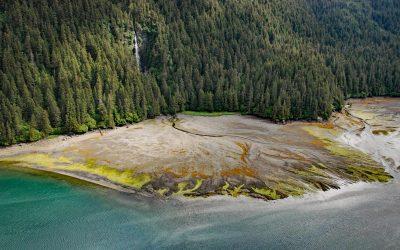
Tutka Bay, Kachemak Bay State Park
Tutka Bay is a deglaciated fjord that extends 8.5 miles (14 km) in Kachemak Bay State Park from Eldred Passage to the mouth of an unnamed river that flows generally west-northwest for 7 miles (11 km) from small remnants of the Southern Glacier, about 18 miles (29 km) southeast of Homer and 15 miles (24 km) east of Seldovia, Alaska.
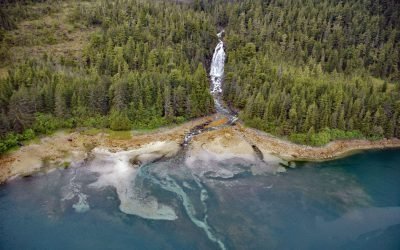
Sahlin Falls, Sheep Bay
Sahlin Falls is located at the base of Sahlin Creek on the northern shore of Sheep Bay, approximately 33 miles (53 km) southeast of Valdez and 13 miles (21 km) northwest of Cordova, Alaska.
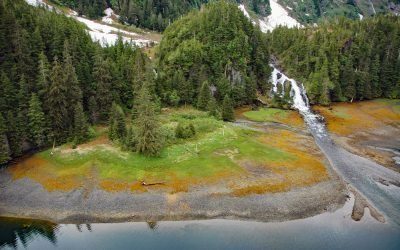
Cliff Falls, Deep Cove
Cliff Falls is the outlet for Cliff Lake, located at the head of Deep Cove, approximately 1.1 miles (1.8 km) west of Patterson Point, about 41 miles (66 km) south-southeast of Sitka, and 17.5 miles (28 km) north-northwest of Port Armstrong, Alaska.

Beaver Falls Creek, George Inlet
Beaver Falls Creek is on Revillagigedo Island, on the western shore of George Inlet, 5.3 miles (8.5 km) northeast of Ketchikan, Alaska.
About the background graphic
This ‘warming stripe’ graphic is a visual representation of the change in global temperature from 1850 (top) to 2019 (bottom). Each stripe represents the average global temperature for one year. The average temperature from 1971-2000 is set as the boundary between blue and red. The colour scale goes from -0.7°C to +0.7°C. The data are from the UK Met Office HadCRUT4.6 dataset.
Click here for more information about the #warmingstripes.