
Historical Sites
Recent Articles
More Articles
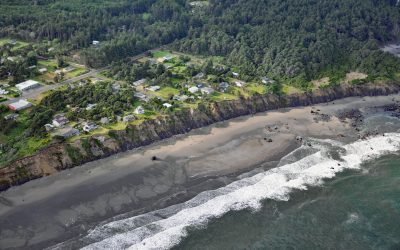
Nesika Beach, Geisel Monument
Nesika Beach is a community located at the south end of the Nesika strand, and the site of the Geisel Monument, about 6 miles (10 km) north of Gold Beach and 4 miles (6 km) south-southeast of Ophir, Oregon.
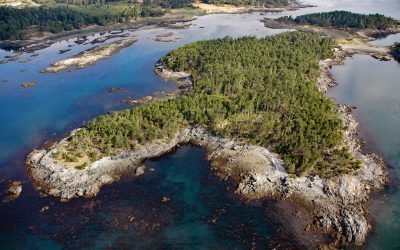
Bentinck Island, Cape Calver
Bentinck Island is situated between Cape Calver and Race Rocks in the Strait of Juan de Fuca, approximately 10 miles (16 km) southeast of Sooke and 11 miles (18 km) southwest of Victoria, British Columbia.
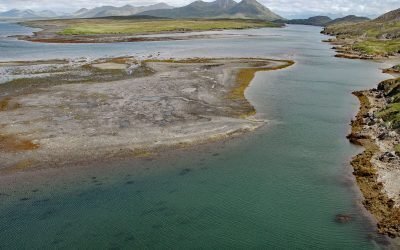
Alitak Lagoon, Tanner Head
Alitak Lagoon lies 1 mile (1.6 km) northeast of Cape Alitak on Tanner Head at the southern end of Kodiak Island, 93 miles (150 km) southwest of the community of Kodiak, Alaska.
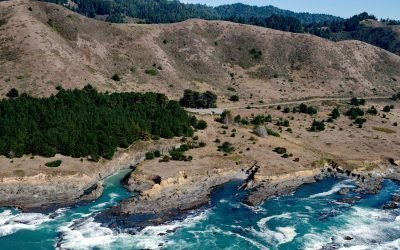
Kibesillah, Mendocino Coast
Kibesillah is the site of a historical lumber-loading chute and for a short time was one of the most important communities on the Mendocino Coast, about 10 miles (16 km) north of Fort Bragg and 3.3 miles (5.3 km) south of Westport, California.

Anchor Glacier, Northwestern Fjord
Anchor Glacier flows east for 3 miles (5 km) to Northwestern Fjord, which is located approximately 52 miles (84 km) east-northeast of Homer and 32 miles (52 km) southwest of Seward, Alaska.
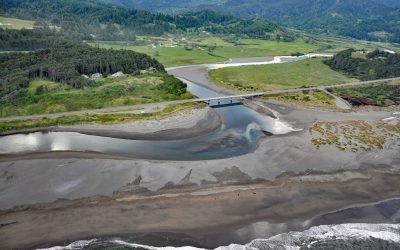
Pistol River, Pistol River State Scenic Viewpoint
Pistol River flows generally southwest for 21 miles (34 km) to the Pistol River State Scenic Viewpoint overlooking the Pacific Ocean near the community of Pistol River, about 17 miles (27 km) north-northwest of Brookings and 10 miles (16 km) south of Gold Beach, Oregon.
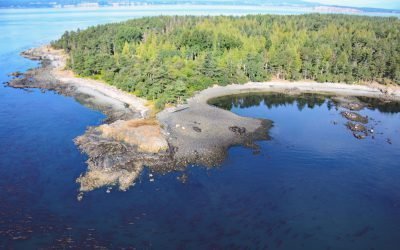
D’Arcy Island, Southern Gulf Islands
D’Arcy Island, part of the Southern Gulf Islands in Haro Strait, covers approximately 205 acres (83 hectares), about 30 miles (48 km) west of Anacortes and 10 miles (16 km) north-northeast of Victoria, British Columbia.
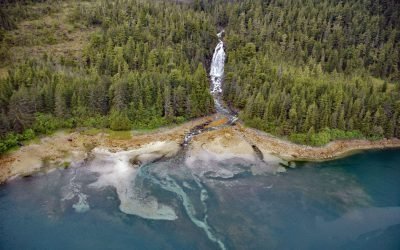
Sahlin Falls, Sheep Bay
Sahlin Falls is located at the base of Sahlin Creek on the northern shore of Sheep Bay, approximately 33 miles (53 km) southeast of Valdez and 13 miles (21 km) northwest of Cordova, Alaska.
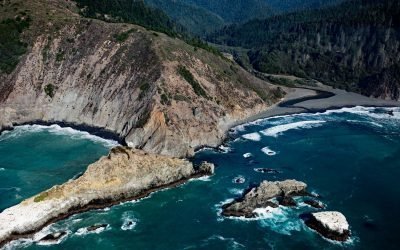
Cottoneva Creek, Rockport Bay
Cottoneva Creek originates at an elevation of approximately 1,300 feet (400 m) in the Coast Range and flows generally south-southwest for 7 miles (11 km) to Rockport Bay, about 11 miles (18 km) southwest of Leggett and 7 miles (11 km) north-northwest of Westport, California.
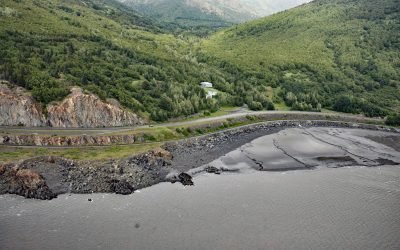
Rainbow Valley, Turnagain Arm
Rainbow Valley is a watershed located on Turnagain Arm between Rainbow Peak to the west and Indianhouse Mountain to the east, approximately 17 miles (27 km) south-southeast of Anchorage and 17 miles (27 km) west-northwest of Girdwood, Alaska.
About the background graphic
This ‘warming stripe’ graphic is a visual representation of the change in global temperature from 1850 (top) to 2019 (bottom). Each stripe represents the average global temperature for one year. The average temperature from 1971-2000 is set as the boundary between blue and red. The colour scale goes from -0.7°C to +0.7°C. The data are from the UK Met Office HadCRUT4.6 dataset.
Click here for more information about the #warmingstripes.