
Historical Sites
Recent Articles
More Articles
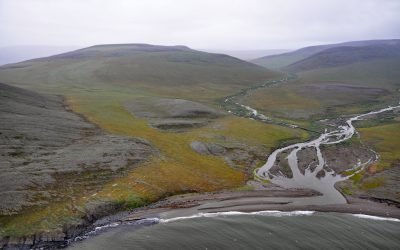
Kapaloak Creek, Cape Dyer
Kapaloak Creek starts from an elevation of roughly 1200 feet (366 m) in the Lisburne Hills and flows generally west for 8.5 miles (14 km) to Cape Dyer on the Chukchi Sea and the site of a historical Iñupiat village, about 110 miles (177 km) southwest of Point Lay and 25 miles (40 km) north-northeast of Point Hope, Alaska.
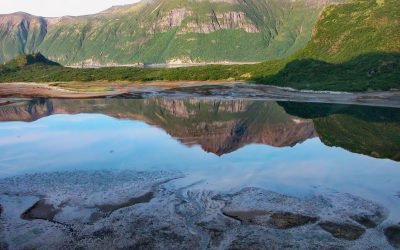
Kuliak Bay, Katmai National Park and Preserve
Kuliak Bay is about 4 miles (6.5 km) wide at the entrance on the western shore of Shelikof Strait and gradually tapers to the northwest for 5 miles (8 km) into Katmai National Park and Preserve on the Alaska Peninsula, about 92 miles (148 km) southeast of King Salmon and 74 miles (119 km) northwest of Kodiak, Alaska.
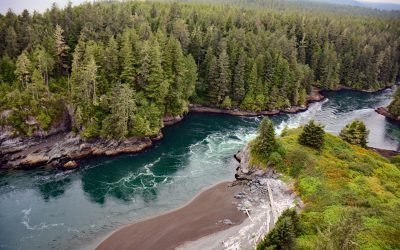
Whyac, Nitinat Narrows
Whyac is a historical Ditidaht First Nation village on the southern shore beside Nitinat Narrows, a tidal channel about 1.9 miles (3 km) long that connects Nitinat Lake to the Pacific Ocean on the north shore of the Strait of Juan de Fuca on Vancouver Island, about 22 miles (35 km) northwest of Port Renfrew and 17 miles (27 km) southeast of Bamfield, British Columbia.

Ipiutak, Tigara Peninsula
Ipiutak is the Iñupiaq name for a prehistorical village that is now an archaeological site and National Historic Landmark on the Tigara Peninsula and the southern shore of Ipiutak Lagoon, about 133 miles (215 km) southwest of Point Lay and 1 mile (1.6 km) northwest of Point Hope, Alaska.
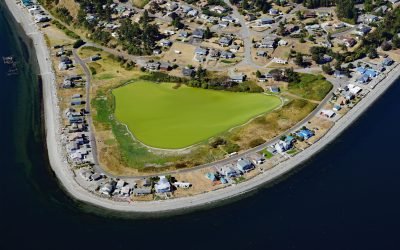
Diamond Point, Discovery Bay
Diamond Point is a community on the northeast tip of the Miller Peninsula which forms part of the Olympic Peninsula on the Strait of Juan de Fuca at the entrance to Discovery Bay, about 44 miles (71 km) northwest of Seattle and 7.5 miles (12 km) west-southwest of Port Townsend, Washington.
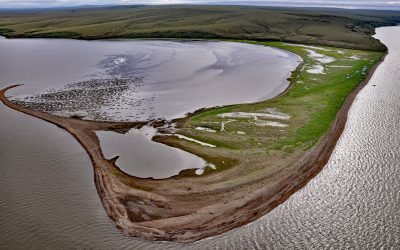
Elephant Point, Eschscholtz Bay
Elephant Point is a headland and the site of a fish camp near a historical reindeer station in Eschscholtz Bay at the head of Kotzebue Sound, about 56 miles (90 km) southeast of Kotzebue and 20 miles (32 km) north-northwest of Buckland, Alaska.
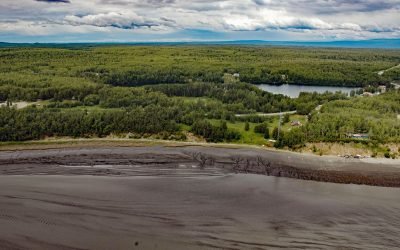
Knik Village, Knik Arm
Knik village is a historic Dena’ina community situated between the northwest shore of Knik Arm in Cook Inlet to the east and Knik Lake to the west, about 18 miles (29 km) north-northeast of Anchorage and 13 miles (21 km) southwest of Wasilla, Alaska.

Fort Miley, Lands End
The Marine Exchange Lookout Station is on Fort Miley at Lands End in the Golden Gate National Recreation Area, about 6 miles (10 km) west of downtown San Francisco and 2.7 miles (4.4 km) southwest of the Presidio at the Golden Gate, California.
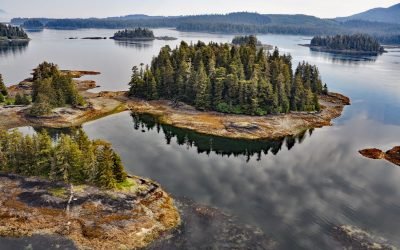
Christmas Island, Security Bay
Christmas Island is the largest of several small reefs and islets on the western coastline and near the entrance to Security Bay on Kuiu Island, about 45 miles (72 km) south of Angoon and 18 miles (29 km) southwest of Kake, Alaska.
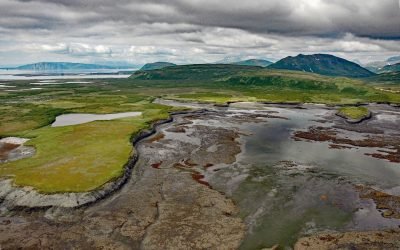
Chenik, Kamishak Bay
Chenik was a historical community at the mouth of Chenik Creek, between Chenik Lake to the west and Chenik Head to the east, on the west shore of Kamishak Bay, about 98 miles (158 km) northeast of King Salmon and 98 miles (158 km) southwest of Homer, Alaska.
About the background graphic
This ‘warming stripe’ graphic is a visual representation of the change in global temperature from 1850 (top) to 2019 (bottom). Each stripe represents the average global temperature for one year. The average temperature from 1971-2000 is set as the boundary between blue and red. The colour scale goes from -0.7°C to +0.7°C. The data are from the UK Met Office HadCRUT4.6 dataset.
Click here for more information about the #warmingstripes.