
Glaciers
Recent Articles
More Articles
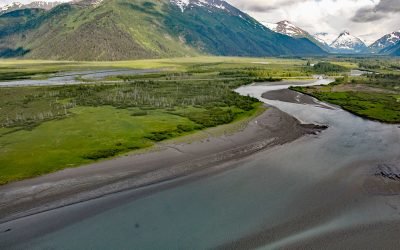
Portage, Turnagain Arm
Portage is a historical community and railroad siding at milepost 64.2 on the Alaska Railroad at the head of Turnagain Arm in the Chugach National Forest, about 41 miles (66 km) south of Anchorage and 11 miles (18 km) northwest of Whittier, Alaska.
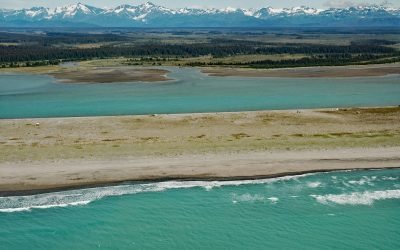
Situk River, Johnson Slough
Situk River starts at Situk Lake and flows southwest for about 18 miles (29 km) through the Yakutat Forelands in Tongass National Forest to Johnson Slough on the Gulf of Alaska, about 200 miles (322 km) northwest of Juneau and 9 miles (15 km) southeast of Yakutat, Alaska.
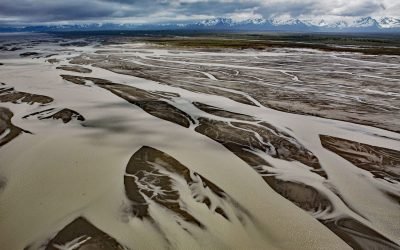
Copper River, Copper River Delta
The Copper River watershed drains about 24,000 square miles (62,000 sq km) in the Wrangell, Chugach, and Saint Elias Mountains and the mainstem flows for about 290 miles (470 km) to the Gulf of Alaska where it creates a wide delta, about 195 miles west-northwest of Yakutat and 30 miles southeast of Cordova, Alaska.
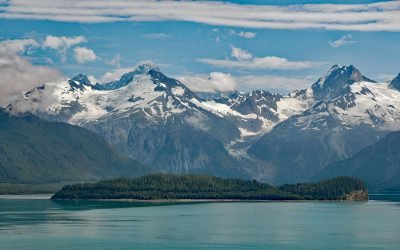
Cenotaph Island, Lituya Bay
Cenotaph Island is approximately in the middle of Lituya Bay, a fjord formed primarily by the Crillon and Lituya glaciers in Glacier Bay National Park and Preserve, about 117 miles (189 km) west-northwest of Juneau and 97 miles (156 km) southeast of Yakutat, Alaska.
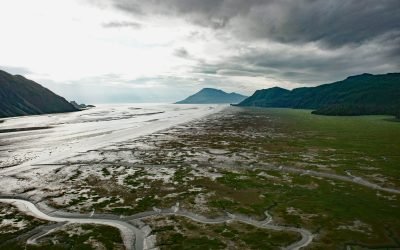
Tuxedni Bay, Cook Inlet
Tuxedni Bay is an estuary that extends southeast for 14 miles (23 km) from the mouth of Tuxedni River to Cook Inlet, at Chisik Island, about 59 miles (95 km) northwest of Homer and 57 miles (92 km) southwest of Kenai, Alaska.
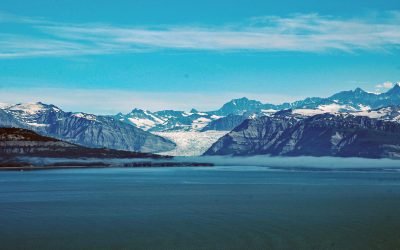
Icy Bay, Wrangell-Saint Elias National Park and Preserve
Icy Bay is on the Gulf of Alaska coast in Wrangell-Saint Elias National Park and Preserve, about 154 miles (248 km) southeast of Cordova and 65 miles (105 km) northwest of Yakutat, Alaska.
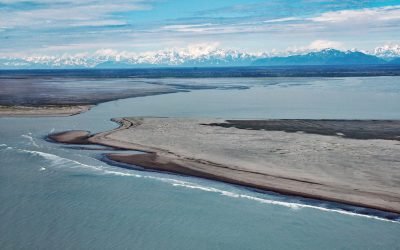
Dangerous River, Brabazon Mountains
Dangerous River starts at Harlequin Lake in the Brabazon Mountains of the Fairweather Range and flows southwest for 16 miles (26 km) to the Gulf of Alaska, about 102 miles (165 km) northwest of Gustavus and 50 miles (81 km) southeast of Yakutat, Alaska.
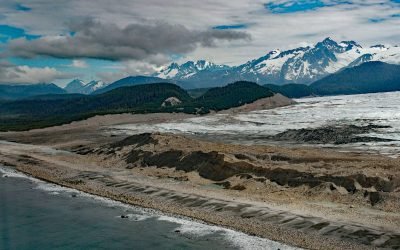
La Perouse Glacier, Fairweather Range
La Perouse Glacier descends from Mount La Perouse in the Fairweather Range and in Glacier Bay National Park and Preserve, about 116 miles (187 km) southeast of Yakutat and 40 miles (65 km) northwest of Gustavus, Alaska.
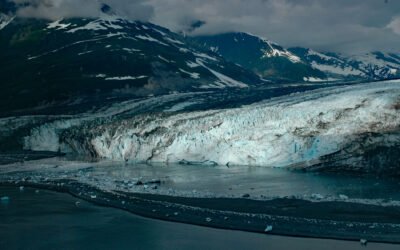
Turner Glacier, Disenchantment Bay
Turner Glacier starts at an elevation of roughly 11,000 feet (3,353 m) on the eastern flank of Mount Cook in the Saint Elias Mountains and flows generally southeast for 21 miles (34 km) to Disenchantment Bay at the head of Yakutat Bay, about 214 miles (344 km) east-southeast of Cordova and 33 miles (53 km) north of Yakutat, Alaska.

Mendenhall Glacier, Juneau Icefield
Mendenhall Glacier starts from an ice divide in the Juneau Icefield at an elevation of 4,300 feet (1,311 m) and flows generally southwest for 15 miles (24 km) to a proglacial lake between McGinnis Mountain to the west and Bullard Mountain to the east, about 11 miles (18 km) north-northwest of Juneau and 5 miles (8 km) northeast of Auke Bay, Alaska.
About the background graphic
This ‘warming stripe’ graphic is a visual representation of the change in global temperature from 1850 (top) to 2019 (bottom). Each stripe represents the average global temperature for one year. The average temperature from 1971-2000 is set as the boundary between blue and red. The colour scale goes from -0.7°C to +0.7°C. The data are from the UK Met Office HadCRUT4.6 dataset.
Click here for more information about the #warmingstripes.