
Glaciers
Recent Articles
More Articles

Blackstone Glacier, Blackstone Bay
Blackstone Glacier flows north for 7 miles (11 km), terminating at tidewater at the head of Blackstone Bay, about 87 miles (140 km) west-southwest of Valdez and 8 miles (13 km) south of Whittier, Alaska.

Cataract Glacier, Surprise Inlet
Cataract Glacier flows to the southern shore of Surprise Inlet, a fjord in Prince William Sound, about 51 miles (82 km) east-southeast of Anchorage and 20 miles (32 km) northeast of Whittier, Alaska.

Tutka River, Kachemak Bay
The Tutka River flows generally westward to the head of Tutka Bay, a fjord on the southern coast of Kachemak Bay, approximately 18 miles (29 km) southeast of Homer and 15 miles (24 km) east of Seldovia, Alaska.

Southwestern Glacier, Northwestern Fjord
Southwestern Glacier is in Northwestern Fjord, a deep embayment in Kenai Fjords National Park and Preserve, about 50 miles (81 km) northeast of Homer and 33 miles (53 km) southwest of Seward, Alaska.

Morse and Muir Glaciers, Glacier Bay National Park and Preserve
Morse and Muir glaciers terminate at the head of Muir Inlet in Glacier Bay National Park and Preserve, approximately 53 miles (85 km) north of Gustavus, Alaska.

Amherst Glacier, College Fjord
Amherst Glacier flows northwest for 4 miles (6.5 km) from the Chugach Mountains to a terminus lake, located 5.5 miles (9 km) northeast of Point Pakenham in College Fjord, the northwestern-most part of Prince William Sound, and 52 miles (83 km) southwest of Valdez, Alaska.

Barry Glacier, Harriman Fjord
Barry Glacier flows southwest for 16 miles (25 km) to Barry Arm of Harriman Fjord in northwestern Prince William Sound, about 33 miles (53 km) northeast of Whittier and 58 miles (93 km) east of Anchorage, Alaska.
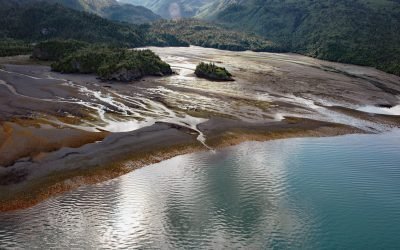
Mallard Bay, Portlock River
Mallard Bay is on the southern shore of Kachemak Bay on the Kenai Peninsula and adjacent to the mouth of the Portlock River, approximately 14 miles (23 km) east-northeast of Homer and 4 miles (6 km) south-southwest of Bear Cove, Alaska.
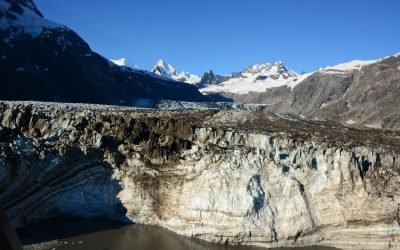
Johns Hopkins Glacier, Glacier Bay National Park and Preserve
Johns Hopkins Glacier flows generally east-northeast for 13 miles (21 km) to the head of Johns Hopkins Inlet in Glacier Bay National Park and Preserve, about 104 miles (167 km) southeast of Yakutat and 58 miles (93 km) northwest of Gustavus, Alaska.
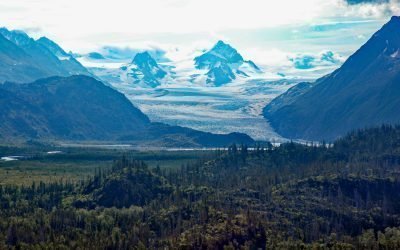
Grewingk Glacier, Kachemak Bay
Grewingk Glacier starts in the Kenai Mountains and flows generally northwest for 11 miles (18 km) to a proglacial lake about 2 miles (3.2 km) long that is drained by Grewingk Creek that flows 3.5 miles (6 km) to the southern shore of Kachemak Bay, about 25 miles (40 km) northeast of Seldovia and 16 miles (25 km) east-southeast of Homer, Alaska.
About the background graphic
This ‘warming stripe’ graphic is a visual representation of the change in global temperature from 1850 (top) to 2019 (bottom). Each stripe represents the average global temperature for one year. The average temperature from 1971-2000 is set as the boundary between blue and red. The colour scale goes from -0.7°C to +0.7°C. The data are from the UK Met Office HadCRUT4.6 dataset.
Click here for more information about the #warmingstripes.