
Communities
Recent Articles
More Articles

Lawson Harbour, Lewis Island
Lawson Harbour was a historical community on Lewis Island between Chismore Passage to the west and Arthur Passage to the east near the mouth of the Skeena River, about 75 miles (121 km) southwest of Terrace and 20 miles (32 km) south of Prince Rupert, British Columbia.
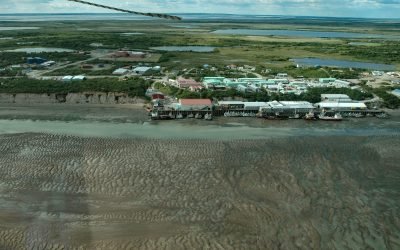
Naknek, Kvichak Bay
Naknek is a community situated on a bluff overlooking the northern bank of the mouth of the Naknek River, at Kvichak Bay which forms the northeastern arm of Bristol Bay, about 56 miles (90 km) southeast of Dillingham and 13 miles (21 km) west-northwest of King Salmon, Alaska.

Stebbins, Saint Michael Island
Stebbins is a community in southern Norton Sound situated on a small sand spit along the northern shore of Saint Michael Island at Cape Stephens, which is in the lee of Stuart Island to the northwest and separated by a channel 1 mile (1.6 km) wide named Stephens Pass, about 117 miles (188 km) southeast of Nome and 52 miles (84 km) southwest of Unalakleet, Alaska.
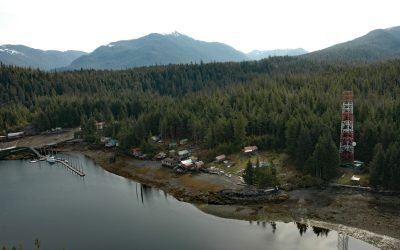
Meyers Chuck, Cleveland Peninsula
Meyers Chuck is a community situated along the shoreline of a natural harbor protected mostly by Misery Island and Meyers Island, on the Cleveland Peninsula with Ernest Sound to the north and Clarence Strait to the west, about 50 miles (80 km) south of Wrangell and 37 miles (60 km) northwest of Ketchikan, Alaska.
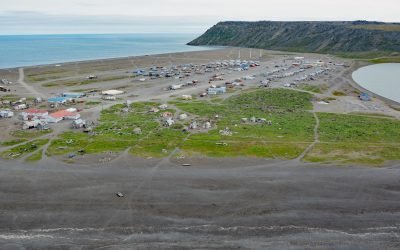
Gambell, Saint Lawrence Island
Gambell is a community on Saint Lawrence Island at Northwest Cape in the northern Bering Sea on a broad, shallow-water continental shelf that extends from western Alaska to northeastern Russia, about 196 miles (316 km) southwest of Nome, Alaska, and 62 miles (100 km) southeast of Provideniya, Russia.

Karluk Village, Kodiak Island
Karluk Village is situated on the southern shore of Karluk Lagoon, an embayment formed by a barrier spit that partially encloses the mouth of the Karluk River, on the Shelikof Strait coast of Kodiak Island, about 77 miles (124 km) west-southwest of Kodiak and 44 miles (71 km) north-northwest of Akhiok, Alaska.
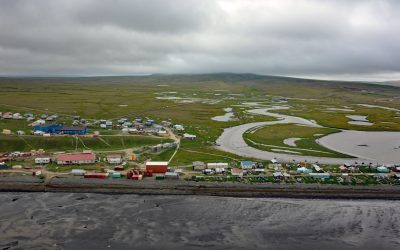
Tununak, Nelson Island
Tununak is a traditional Central Yup’ik community located on the northwest coast of Nelson Island on a narrow barrier spit between the Bering Sea and the mouth of the Tununak River, about 119 miles (192 km) west-southwest of Bethel and 71 miles (114 km) south-southeast of Hooper Bay, Alaska.

Hoonah, Port Frederick
Hoonah is a community situated on the eastern shore of Port Frederick on the northeastern coast of Chichagof Island in the Alexander Archipelago of Southeast Alaska, about 40 miles (64 km) west-southwest of Juneau and 24 miles (39 km) south-southeast of Gustavus, Alaska.
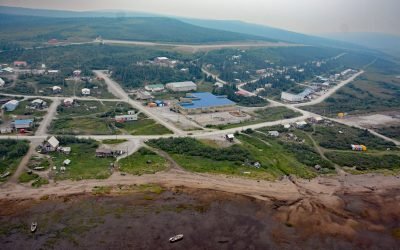
Koyuk, Norton Bay
Koyuk is an Iñupiaq community situated at the head of Norton Bay on the right bank of the Koyuk River estuary on the Seward Peninsula, about 129 miles (208 km) east-northeast of Nome and 40 miles (64 km) north of Shaktoolik, Alaska.

Fort Tongass, Nakat Bay
Tongass Island is the historical site of Fort Tongass located near the southern extent of the Alexander Archipelago in Southeast Alaska about 4.5 miles (7 km) north of the Canadian Border, bounded by Nakat Bay to the west and a channel called Port Tongass to the east, about 19 miles (31 km) northwest of Lax Kw’alaams, British Columbia and 54 miles (87 km) southeast of Ketchikan, Alaska.
About the background graphic
This ‘warming stripe’ graphic is a visual representation of the change in global temperature from 1850 (top) to 2019 (bottom). Each stripe represents the average global temperature for one year. The average temperature from 1971-2000 is set as the boundary between blue and red. The colour scale goes from -0.7°C to +0.7°C. The data are from the UK Met Office HadCRUT4.6 dataset.
Click here for more information about the #warmingstripes.